
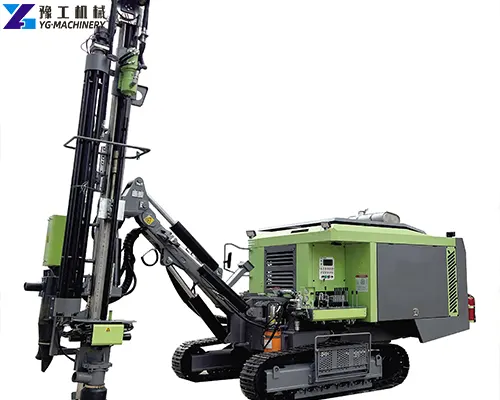
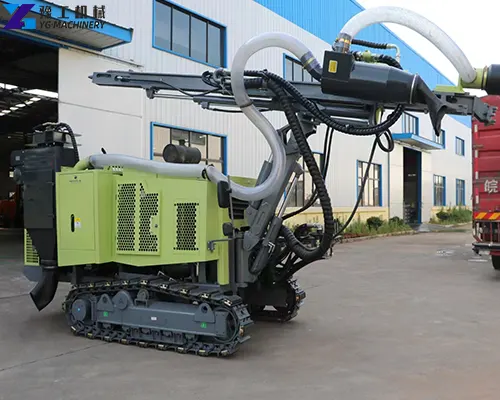
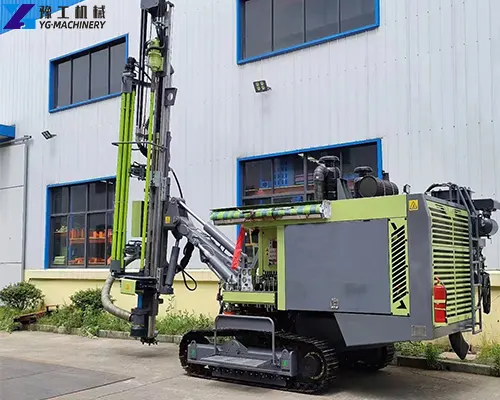
Traditional split-type rock drilling equipment requires separate configurations of the drilling rig and air compressor, resulting in cumbersome pipeline connections, inconvenient relocation, and significant air pressure loss—a persistent pain point for small and medium-sized mines and quarries. The integrated down-the-hole drilling rig, also known in the industry as a single open-pit down-the-hole drilling rig, tracked down-the-hole drill, or fully integrated rock drilling rig, is a complete rock drilling system that integrates the drilling system, high-pressure screw air compressor, power system, and dust collection system onto a single tracked chassis. Unlike split-type down-the-hole drilling rigs, it eliminates the need for external air compressors and connecting air pipes, allowing for immediate use upon relocation and making it suitable for small and medium-sized projects with dispersed work sites.
This equipment also belongs to the high-end down-the-hole drilling machine category and is currently sold in bulk to resource-rich countries such as Ghana, Australia, South Africa, Peru, and Indonesia, and is widely applicable to hard rock drilling scenarios such as open-pit quarries, small and medium-sized metal mines, and infrastructure rock excavation projects. As a professional DTH drilling rig manufacturer, YG offers both integrated and split models, allowing for flexible selection based on budget and working conditions. Contact YG now for more product information.
Click to Get More Information About Down-the-Hole Drilling Rigs
YG Hot-sale Integrated DTH Mine Drilling Rig Technical Parameter
| Model | YG-ZT5 |
| Drilling diameter | 90~105mm |
| Rock hardness | f=6~20 |
| Drilling depth | 24M |
| Number of rods | 7+1 |
| Transport dimensions (L×W×H) | 8850*2180*2830 mm |
| Weight | 13800Kg |
| Ground clearance | 430mm |
| Leveling angle of track | 10°up, 10°down |
| Travelling speed | 0-3Km/h |
| Gradeability | 25° |
| Max push-pull force | 120KN |
| Rotary torque(Max) | 1680N·m(Max) |
| Rotation speed | 0-120rpm |
| Method of propulsion | Motor+roller chain |
| Lifting angle of drill boom | Up 47 °, down 20 ° |
| Swing angle of drill boom | Right 20°, left 50° |
| Swing angle of carriage | Right 35°, left 95° |
| Leveling angle of the frame | Up 10 °, down 10 ° |
| Tilt angle of beam | 120° |
| Compensation stroke | 1200mm |
| Feed stroke | 3490mm |
| Specifications of drilling rod | Φ60×3000 mm |
| Engine | Yuchai YCAO7240-T300 |
| Output power | 176KW/2200rpm |
| Fuel consumption | 20~25L/H |
| Air capacity | 12m3/min |
| Air pressure | 15Bar |
| Method of dust collecting | Dry type(hydraulic cyclonic laminar flow) |
Click to Get More Information About Down-the-Hole Drilling Rigs
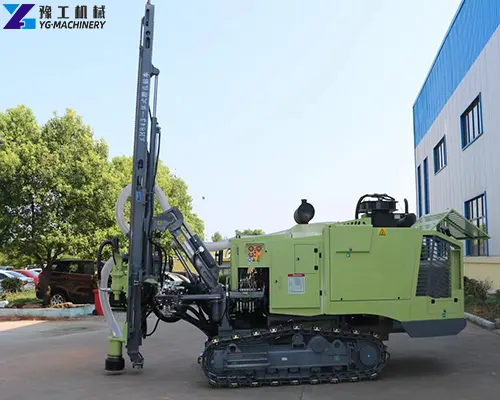
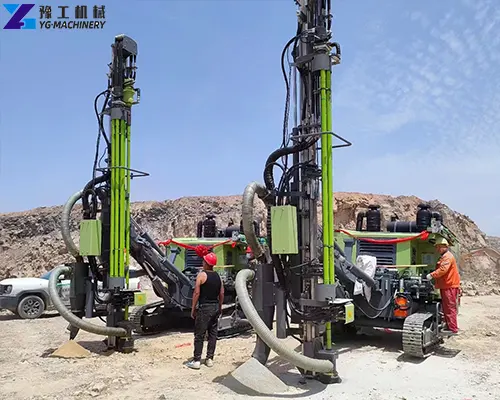
7 Applications & Use Cases of Yugong Machinery Integrated Down-the-Hole Drill Rigs
- Open-pit mining blasting hole drilling. This is the core application area. Mining companies use it to drill blasting holes in hard rock deposits such as limestone, iron ore, copper ore, and gold ore, creating conditions for explosive loading. In an African copper mine project, the drilling efficiency for blasting holes with a diameter of 152 mm and a depth of 16 meters can reach 416 meters per day.
- Water conservancy projects and farmland irrigation well drilling. In mountainous areas and remote villages with water shortages, integrated down-the-hole drill rigs rely on their own power and air compressor to quickly complete well construction without external electricity or water sources.
- Geotechnical engineering investigation and foundation testing. Engineering investigation teams use small to medium-sized integrated drill rigs to complete soil sampling and bedrock calibration, providing geological data support for bridge, highway, and industrial building foundations.
- Road engineering slope protection and anchoring. Rock slope reinforcement and anchor cable drilling operations in highway and railway construction require equipment with mountainous terrain mobility and precise drilling control.
- Quarrying. Small and medium-sized quarries use integrated down-the-hole drills (DHDs) to drill graded stone extraction holes. The machine’s mobility and drilling efficiency meet the demands of high-intensity shift work in quarries.
- Tunnel engineering and underground chamber construction. In high-altitude tunnel and mine roadway excavation, integrated DHDs equipped with dry dust removal systems can complete anchor bolting and advanced drilling operations within confined spaces.
- Geothermal energy exploration and deep geothermal drilling. With the accelerated development of global geothermal energy, integrated drilling rigs suitable for depths of 300 to 500 meters are increasingly widely used in geothermal projects, especially in the geothermal regions of East Africa and Southeast Asia.
Click to Get More Information About Down-the-Hole Drilling Rigs
Integrated vs. Split-Type: How to Choose the Right Down-the-Hole (DTH) Rig for Your Needs?
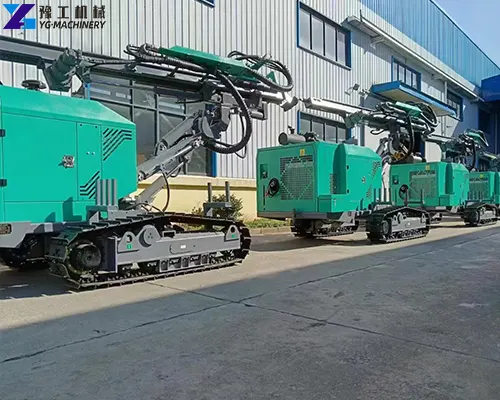
Integrated DTH Rigs integrate the air compressor into the rig body, resulting in a compact design and rapid relocation, suitable for projects with frequent site changes. The purchase cost does not include the additional cost of the air compressor, but the built-in air compressor cannot be replaced separately, limiting flexibility. Maintenance is handled by a single manufacturer, and the parts system is clear, making it more suitable for small and medium-sized contractors and teams with limited equipment management capabilities.
Split-Type DTH Rigs offer a separate configuration for the rig and air compressor, resulting in a lower overall purchase price. The air compressor can be selected and upgraded separately based on drilling depth and air pressure requirements. The split-type solution is suitable for deep hole operations exceeding 300 meters in depth and requiring air pressure exceeding 25 bar, or for users who already have compatible air compressor equipment. The disadvantages are the need to transport both units separately, longer commissioning time, and higher technical requirements for the operating team.
Selection Recommendations: If your project primarily involves small to medium depth blasting holes (100 to 300 meters), with dispersed work sites and frequent site changes, an integrated solution offers lower overall costs. If your project has greater depth, higher air pressure requirements, and your team has experience in equipment coordination, a modular solution offers better long-term cost-effectiveness.
Click to Get More Information About Down-the-Hole Drilling Rigs
Frequently Asked Questions About the YG Integrated Down-the-Hole Drill Rig
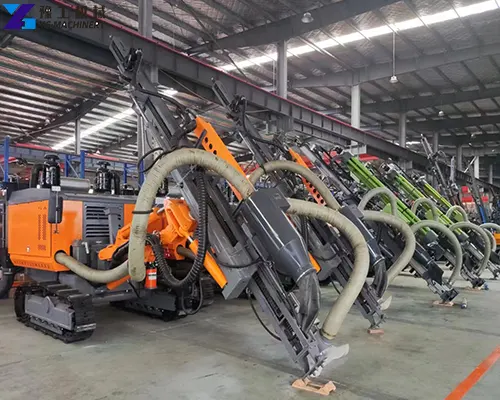
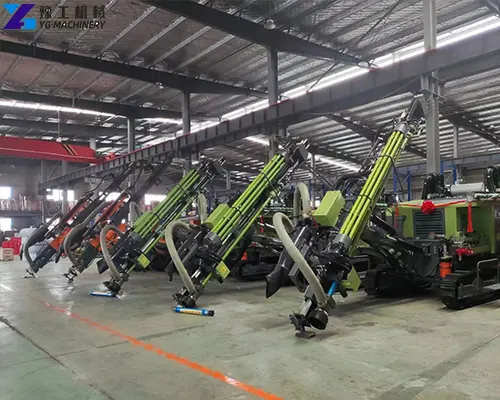
A1: Absolutely. The integrated down-the-hole drill rig, equipped with a compatible DTH hammer and hard rock drill bit, can effectively drill into high-hardness rock formations such as granite, basalt, and siliceous limestone. Drilling performance depends on the impact energy level of the DTH hammer and the drill bit tooth profile selection. The YG series supports stepless speed regulation from 0 to 140 rpm, allowing the operator to adjust the rotation speed and thrust matching parameters in real time according to the rock hardness to achieve the optimal drilling speed.
A2: The built-in air compressor of the integrated drill rig is an integrated core module design. Repairs require replacement or deep maintenance under the manufacturer’s guidance. If high replaceability of the air compressor is required, a separate unit solution is recommended during the selection phase. If choosing an integrated model, daily maintenance should strictly follow the air compressor maintenance cycle (usually changing the oil and filter every 500 hours) to effectively extend the service life of the built-in air compressor and reduce the failure rate.
A3: In standard configuration, one operator with driving and drilling operation qualifications can complete all operations, including walking and positioning, drilling parameter adjustment, automatic rod changing, and daily equipment checks. Some models equipped with automatic drilling control systems support semi-automated operation, further reducing labor intensity. A support operator is usually needed for site relocation and equipment mounting.
A4: If the project mainly involves shallow to medium depth (100 to 300 meters) blasting holes and water wells, with dispersed sites and frequent relocations, the integrated solution has a lower overall cost. If the drilling depth exceeds 300 meters, the air pressure requirement exceeds 25 bar, or you already have suitable air compressor equipment, the split-type solution has a more advantageous long-term operating cost. For initial purchases, we recommend selecting the model based on your maximum drilling depth requirements; there’s no need to pay extra for capabilities exceeding specifications.
A5: The standard model typically takes 15 to 30 working days from order confirmation to completion of production and inspection. For export shipping, YG offers quotations for various trade terms such as FOB, CIF, and DDP, assisting customers with customs clearance and delivery at the destination port.
A6: Yes, but a high-altitude-specific configuration is required. The standard model’s operating altitude is typically limited to below 1500 meters. Above this altitude, a high-altitude air compressor and an enhanced engine intake system are required. In extremely cold regions (minimum temperatures below -25°C), a low-temperature start-up assistance system and an engine preheating device are also necessary. Please specify your expected operating altitude and minimum temperature when ordering, and YG will match a suitable configuration accordingly.