
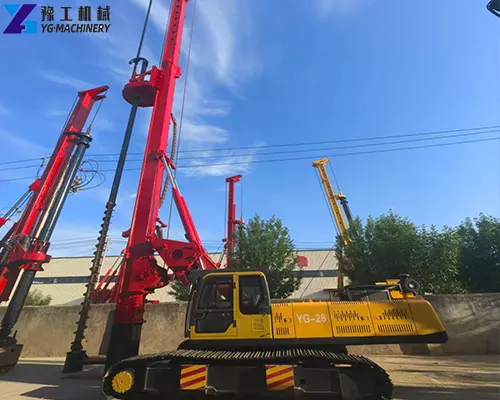
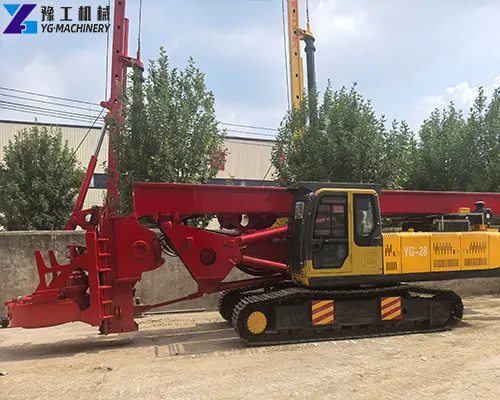
When working in densely built-up urban areas, have you encountered challenges like these? Traditional piling methods cause excessive vibration, leading to cracks in nearby buildings; noise complaints force work stoppages; or high groundwater levels cause repeated borehole wall collapses. The root cause of these issues is often the choice of the wrong piling method. Continuous Flight Auger (CFA) piling rigs are replacing traditional piling methods worldwide. Their key advantages include: vibration-free and low-noise drilling, direct concrete pouring during auger extraction, and the ability to complete 300–450 meters of piling in a single day. For soft soil or high-groundwater strata, CFA piling is virtually the only solution that simultaneously meets efficiency, quality, and environmental standards.
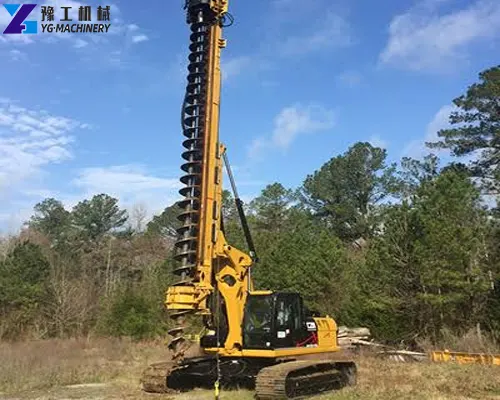
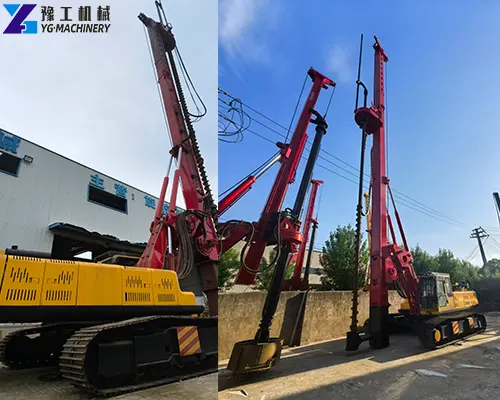
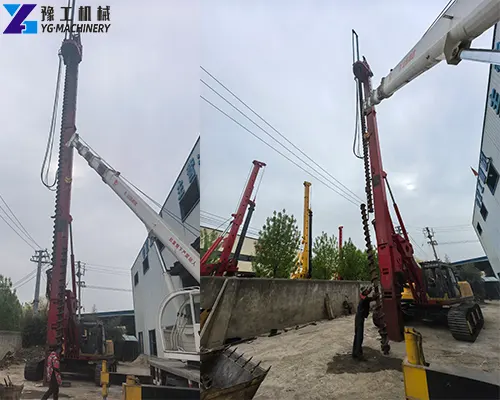
You can visualize a CFA piling rig as a “giant screw.” Its operation involves three steps:
- Drilling: The auger rotates into the ground, conveying soil to the surface along its helical flights. No casing or bentonite slurry is required to stabilize the borehole walls—the auger itself acts as the “casing.”
- Concrete Pouring: Once the design depth is reached, concrete is pumped through the hollow center of the auger stem at a pressure of 15–30 bar. Simultaneously, the auger is slowly withdrawn at a rate of 0.9–2.4 meters per minute, filling the entire borehole with concrete from the bottom up.
- Reinforcement Cage Insertion: Before the concrete begins to set (typically within 30–45 minutes), a prefabricated reinforcement cage is inserted into the wet concrete using a vibrator or simply by its own weight.
If you are interested, please contact us today for more product information.
Click to Learn More Details About the CFA Piling Rig
Hot-sale YG Continuous Flight Auger Piling Rig (CFA Pile Driver) Technical Parameters
| Item | Unit | Data | |
| vehicle parameters | Dimensions | mm | 7300X2100X2850 |
| minimum gap | mm | 230 | |
| wheel track | mm | Front 1860, back 1920 | |
| wheelbase | mm | 2650 | |
| Upright height | mm | 7500 | |
| Telescopic trajectory | mm | 800 | |
| total weight | kg | 6500 | |
| tire size | / | Front 700-16, back 750-16 | |
| traveling speed | km/h | 40 | |
| Gradeability | ° | 25 | |
| Diesel engine | Model | / | Quanchai 485 |
| power | kw | 34 | |
| Rotary speed | r/min | 2200 | |
| Generator set | power | kw | 40-50 |
| Hydraulic system | Wedge pressure | mpa | 16-20 |
| Outrigger pressure | mpa | 16-20 | |
| Max pressure | mpa | 20 | |
| Main pump flow | l/min | 32 | |
| Working range | Piling hole diameter | mm | 100-800 |
| Piling hole depth | m | 6-10 | |
| Drill pipe speed | r/min | 40-65 | |
| Drill pull force | KN | 100 | |
| rotation angle | ° | 360 |
Click to Learn More Details About the CFA Piling Rig
What Are the Primary Applications for CFA Piling Rigs?
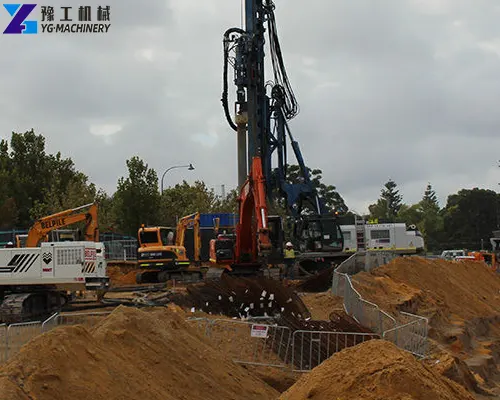
- Pile foundations for urban residential and commercial buildings. Featuring vibration-free and low-noise operation, they allow for daytime construction without disturbing residents or requiring frequent work stoppages during peak hours. They are particularly well-suited for new real estate developments and commercial complexes in densely populated urban areas.
- Renovation of older residential communities and structural reinforcement. With a compact design allowing for close-proximity operation—requiring a minimum working clearance of just 1.5 meters—these rigs eliminate the need to demolish or alter surrounding structures. They are ideal for foundation reinforcement and vertical expansion projects involving older buildings.
- Pile foundations for municipal roads and bridge pile caps. High construction efficiency—averaging 10–15 piles per day per unit—significantly shortens municipal project timelines and minimizes traffic disruption.
- Industrial plant foundations in soft-soil regions. The pumping pressure compacts the soft soil surrounding the pile, indirectly enhancing the foundation’s load-bearing capacity. This makes them suitable for constructing factories and logistics parks in coastal or riverside areas characterized by high water tables and soft soil.
- Support piles for underground garages and deep foundation pits. The continuous flight auger supports the borehole wall throughout the process, preventing collapse even in high-water-table strata. This makes them ideal for foundation pit support piles and water-cutoff curtain piles, eliminating the need for additional dewatering measures.
- Pile foundations in sensitive areas along subway lines. The absence of impact vibration results in negligible settlement of surrounding structures, ensuring safety for existing subway lines and older buildings while meeting construction requirements for subway protection zones.
- Foundation construction for new energy power plants. Projects such as photovoltaic step-up stations and wind turbine tower foundations involve large numbers of piles distributed over wide areas; the equipment offers flexible mobility and rapid piling speeds, making it ideal for large-scale field operations.
- Pile foundations for riverbank revetments and water conservancy projects. Capable of operating effectively in high-water-table and soft-soil conditions, these rigs allow for direct bank-side operation without the need for artificial islands or cofferdams, significantly reducing construction costs for water conservancy projects.
Click to Learn More Details About the CFA Piling Rig
CFA Piling Rigs vs. Traditional Piling Rigs: What Are the Key Differences?
| Comparison Criteria | CFA Piling Rig | Traditional Bored Pile | Driven Pile |
| Construction speed | 150–450 m/day; 25–50% faster | 80–150 m/day | 100–200 m/day |
| Vibration and noise | Extremely low; allows construction as close as 1.5 m to existing structures | Low | Very high; requires a clearance of 30m+ |
| Casing/slurry requirement | Not required; the auger stem provides borehole support | Requires casing or bentonite slurry | Not required |
| Groundwater level adaptability | Excellent; concrete pressure automatically seals against water inflow | Average; prone to borehole collapse in high water tables | Average |
| Site footprint | Low; 40% reduction compared to traditional methods | Large; requires slurry pits and casing storage areas | Moderate |
| Waste generation | Minimal | Large volume of slurry waste requires off-site disposal | None |
| Comprehensive cost per pile | Reduced by 20–30% | Baseline | Moderate |
| Suitable soil/rock strata | Soft soil, sand, silt, clay | Almost all strata | Soft soil to medium-dense sand |
| Maximum pile diameter | 300–1200 mm | 600–1500 mm+ | 300–600 mm |
| Maximum pile depth | 15–35 m (up to 50 m+ for special applications) | 50–100 m+ | 15–40 m |
Key Conclusion: If your project involves pile depths of up to 35 meters, strata primarily composed of soft soil, sand, or silt, and a site with limited space or proximity to existing structures, a CFA piling rig is the most cost-effective choice.
Click to Learn More Details About the CFA Piling Rig
FAQ: Frequently Asked Questions About CFA Piling Rigs
A1: Not really. The CFA method excels in soft soil, sand, silt, and clay formations. When encountering hard rock with a Uniaxial Compressive Strength (UCS) exceeding 50 MPa, drilling efficiency drops sharply, and drill bit wear accelerates. In such cases, using a rotary drilling rig equipped with a core barrel bit is recommended.
A2: They are highly suitable. The continuous flight auger supports the borehole wall throughout the process, preventing collapse without the need for temporary casings or bentonite slurry; the method’s advantages are particularly evident in soft soil areas with high water tables.
A3: In soft soil formations, because concrete is injected under pressure during CFA construction, it exerts radial pressure on the surrounding soil, increasing side friction by 35–110%. Consequently, for the same pile diameter and depth, CFA piles typically offer higher load-bearing capacity than traditional bored piles.
A4: For a pile with a 600mm diameter in soft soil, the comprehensive cost per meter is 20–30% lower than that of traditional cast-in-place bored piles. Specific prices depend on pile depth, geological conditions, and local material costs; please contact YG for an accurate estimate.
A5: Standard tests include: ① Low-Strain Integrity Testing (LSIT), usually performed 7 days after concreting; ② Static Load Test, to verify load-bearing capacity; and ③ Cross-hole Sonic Logging (CSL), used for critical projects. Real-time monitoring data from modern CFA rigs also serves as a vital quality control record.
A6: The CFA rig itself occupies an area of approximately 6m × 3m; including the concrete pump truck and the rebar cage storage area, a minimum working area of about 15m × 10m is sufficient. This reduces site space requirements by approximately 40% compared to traditional bored piling methods (which require slurry ponds and casing storage areas).
Click to Learn More Details About the CFA Piling Rig
Conclusion: CFA piling rigs are the optimal solution for construction on soft soil foundations.
Key Advantages of CFA Piling Rigs:
- High construction efficiency: 25–50% faster than traditional bored piles, with a daily output of 300–450 meters.
- Low total cost: Despite higher initial equipment costs, the total cost of ownership is reduced by 25–45%.
- Environmentally friendly: Zero vibration, low noise, and no slurry waste; allows for construction as close as 1.5 meters to existing structures.
- Reliable quality: Pressure grouting enhances the strength of the surrounding soil, resulting in higher load-bearing capacity compared to equivalent bored piles.
- High adaptability: Particularly suitable for complex conditions such as soft soil, high groundwater levels, and densely populated urban areas.
The global CFA piling rig market is expanding steadily at a compound annual growth rate (CAGR) of 5.8%, with the Asia-Pacific region leading the market with a 45.2% share.
Act Now
📞 Get a free construction plan and quote
- WhatsApp / WeChat / Phone: +86 136 1385 6800
- Email: sales@drillmachinechina.com
YG offers comprehensive services—ranging from equipment selection and geological suitability analysis to construction plan design—to help you find the CFA piling rig configuration best suited to your project.